Artificial General Intelligence
This course explores theories and methodologies for developing AI systems capable of human-level general problem-solving abilities. Students will study various approaches including large models, program synthesis, meta-learning, representation learning, and neuro-symbolic methods, while examining current research trends in improving abstraction and reasoning capabilities. The course includes practical projects where students design and implement general-purpose AI systems.
- Time: Mon/Wed 9:00am-10:30am (Fall 2026)
- Venue: TED-Hall
- Codes: AI5102
- Prerequisites: Students are expected to have solid understanding on machine learning and deep learning (AI5213, AI5214).
Notice
- HW2 is released.
- HW1 is released.
- We will start our first lecture at 9/2 (Wed).
Useful Links
- Access the AI5102 Ed Discussion forum. If you haven’t already been added to the class, use this invitation link.
- Use your full name in the format “Firstname Lastname” with the first letter of each name capitalized (e.g., Sundong Kim).
- Don’t forget to use your valid GIST email address.
- Submit your assignments at the AI5102 Gradescope. Entry code is 4DBD25. Make sure to enter your correct student ID.
- Use the same name format as for Ed Discussion: “Firstname Lastname” with the first letter of each name capitalized. (e.g., Sundong Kim).
- Make sure to enter your correct student ID and your valid GIST email address.
Syllabus
We don’t have official textbook, but we will cover papers relevant to the topic. Main readings will be based on recent research papers and technical reports in the below syllabus/slides.
Related readings:
- Tentative topics for your presentation (Will be announced soon)
- Material posted in the Ed dicussion page
- Book: Artificial General Intelligence (Julian Togelius)
Student presentations are colored in orange.
| Week | Description | Readings | Homeworks |
|---|---|---|---|
| 8/31 | |||
| 9/2 | Opening (Introduction: p.1) | Sign-up Survey | |
| 9/7 | Opening (Refining problems: p.25) | ||
| 9/9 | Invited Talk (Gabriel Lima; on AI Governance) | ||
| 9/14 | Potential Safety Issues around General Intelligence (Recent News: p.42) | HW1 (Due: 10/2) | |
| 9/16 | Opening (A benchmark for measuring intelligence: p.53) | ||
| 9/21 | Opening (What comes after these efforts: p.74) | ||
| 9/23 | Recent trends around ARC-AGI-1/2: (Slides p.111) | ||
| 9/28 | Recent trends around ARC-AGI-1/2: (Slides p.175) | ||
| 9/30 | Recent trends around ARC-AGI-3: (Slides p.221) | HW2 (Sign-up Due: 10/9) | |
| 10/5 | National Holiday (개천절 대체공휴일) | ||
| 10/7 | Meta-Learning & Trustworthy ML — Byungchang Kim (TA) | ||
| 10/12 | Invited Talk (Seokki Lee; on The Five Tribes of Machine Learning) | ||
| 10/14 | Model-Based RL and Othello | ||
| 10/19 | Midterm Week | ||
| 10/21 | Midterm Week | ||
| … | … | ||
| 10/26 | Invited talk (Seungpil Lee) | ||
| 10/28 | Embodied AI + Memory (Sungwoo Kang, Abishev Temirlan) | ||
| 11/2 | Recursive Self-Improvement & Automated AI Research (Minseo Koo, Dogyun Kim) | ||
| 11/4 | TBD | ||
| 11/9 | AI for Science: the AlphaFold Line (Kyungmin Choi, Ijaz Muhammad Nauman) | ||
| 11/11 | TBD | ||
| 11/16 | World models & Planning (Mathys Lampe, Ahmed Loughzali) | ||
| 11/18 | TBD | ||
| 11/19 | Invited Talk (Jea Kwon, on Brain-inspired Memory for AI) | Thursday 4pm; optional | |
| 11/23 | Looped Transformer (Juhyeon Park, Youngho Kim) | ||
| 11/25 | TBD | ||
| 11/30 | AI for Mathematics (Yaqoob Ali, Ding Weijian) | ||
| 12/2 | Agents & Cognitive Architectures (Kangbeen Ko, Tsikhan Khodasau) | ||
| 12/7 | TBD | ||
| 12/9 | No class (NeurIPS week) | ||
| 12/14 | Course Wrap-up (LAST LECTURE) | ||
| 12/16 | No class (Final Exam Period) |
Staffs
Communication: The course schedule and all resources will be posted on this course website. All class discussions, announcements and other communication will take place via Ed Discussion. Use the public comments if your question is relevant to the course material. We aim to respond to questions within 2 business days, often sooner. If you need to contact the course staff, please make a private question on Ed instead of sending a personal email. You’re free to visit TAs during office hours.
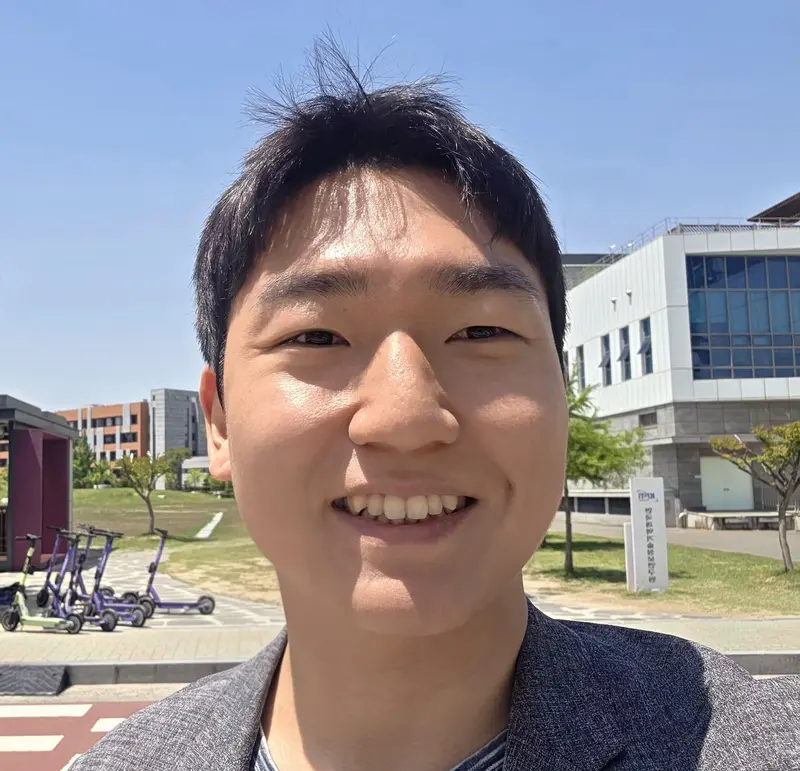
Sundong Kim
Instructor
QnA: After class (Lecture room) or Ed discussion
Office: AI Building (S7), Room 204

Byungchang Kim
TA
QnA: After class (Lecture room) or Ed discussion
Office: RISE Bldg #205

Mohammad Saadati
TA
QnA: After class (Lecture room) or Ed discussion
Office: AI Building (S7), 1F Metaverse Studio

Byungrae Cha
Staff
QnA: After class (Lecture room) or Ed discussion
Office: Kumho Hall (C4), 3F
Homeworks
Submit your assignments at the AI6105 Gradescope.
- HW 1 is due Sunday, Oct 2 at 11:59PM
- HW 2: TBD
- HW 3: TBD
- HW 4: TBD
- HW 5: TBD
Late policy for homeworks: If assignments are late, they are increasingly penalized as follows: within 24 hours, you lose 10%; within 48 hours, you lose 20%; within 72 hours, you lose 40%. More than three days late, you can no longer hand-in the assignment.
- Grading will be completed within two weeks after the deadline, and students will then have five days to request a regrading on Gradescope.
Gradings
You will earn A if (but not only if) your score is at least \(80\times(1-ε_1)\%\) of the total score, B if your score is at least \(60\times(1-ε_2)\%\), C if your score is at least \(40\times(1-ε_3)\%\), for some \(ε_i ≥ 0\) to be determined later. All participants in the course are evaluated equally, regardless of the course codes.
- Homeworks (100%)
